Magic: The Gathering
Spellslinger Starter Kit
The Project:
After several years without a starter product available at mass market retail, Magic launched the Spellslinger Starter Kit, an onboarding experience for two players.
This product included a guided demo experience with two Z-fold quick start guides, collated decks, and a rules booklet for reference.
My Role:
As the Magic R&D editor charged with creating learn-to-play materials, I was the vision-holder for this project over the course of three product generations.
I partnered with the game design lead to select cards and interactions to teach, wrote all the instructional text, then presented a wireframe design to the creative group. I led several iterative brainstorming sessions with graphic designers to develop layouts and iconography.
I also participated in evaluating this product at subsequent market-testing sessions to assess its effectiveness, using the data we collected to make improvements from version to version.
These are the Z-fold play guides from the final iteration of this product. The central game design challenge for these was developing them to refer to the gameplay script (and specific card interactions) from each player’s point of view. The core UX design principle for these guides was to let the visuals tell as much of the story as possible, using text sparingly where necessary. A key learning from focus-group testing of previous intro products was that players bounce off of walls of text, so this product was designed to provide gameplay information at the moment that information became relevant.
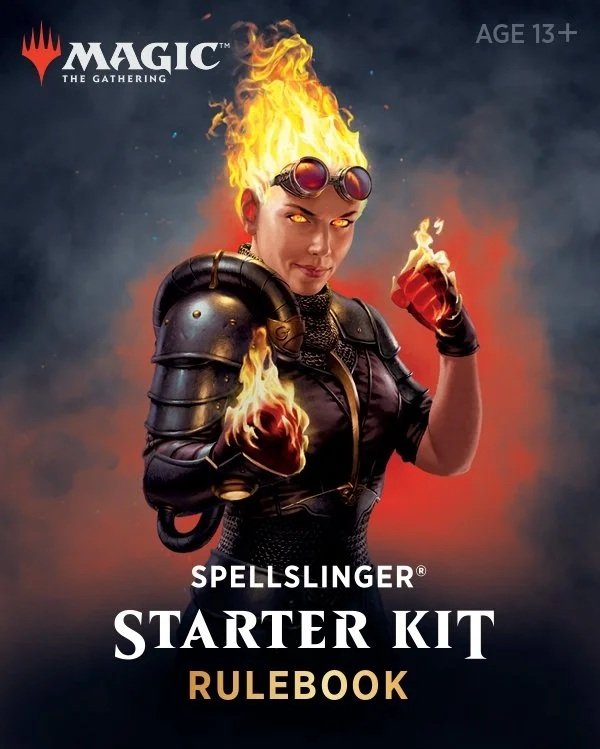
This generalized rulebook was also provided as a reference guide to accompany the demo experience. All the concepts and game rules terms contained within the demo had fleshed-out explanations in the rulebook, and an FAQ was also included on the back page based on player questions in focus-group testing. Narrowing the scope of this book to only those Magic concepts present in the demo decks was also a key decision in development—one of the most persistent reasons players bounce off of strategy games is the introduction of too much complexity too quickly.
Further Development Background
The Z-folds and rulebook from a previous iteration of the starter kit:
My wireframe mockups.